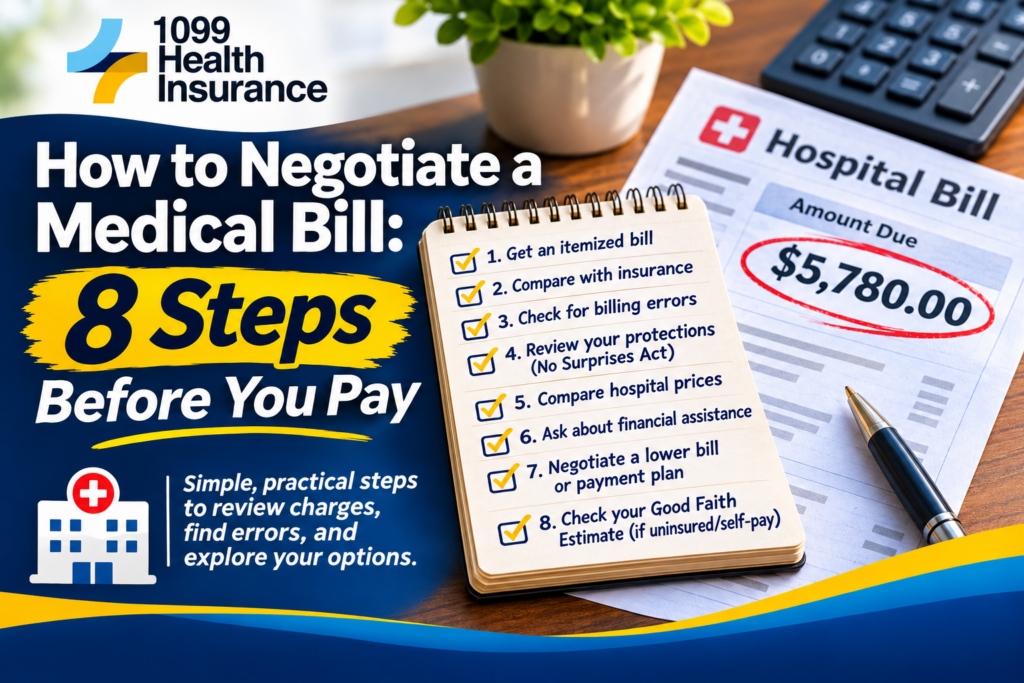
How to Negotiate a Medical Bill: 8 Things to Do Before You Pay
You Got a Hospital Bill. Now What?
Picture this. You went to the hospital a few weeks ago. You have health insurance, so you figured you were covered. Then an envelope shows up, and the bill says you owe $4,800.
Your first thought might be, “Do I just pay it?” Take a breath first. A hospital bill is worth checking before you pay. Checking it does not guarantee a discount, but it helps you understand what you owe and what to ask.
You are far from alone. In 2023, 16.4% of U.S. households had medical debt, and the median amount owed among those households was $2,000, according to the U.S. Census Bureau’s Wealth of Households: 2023 report.
I’m Luis Carmona, an independent licensed health insurance advisor with 1099 Health Insurance. I work with self-employed people, 1099 contractors, freelancers, families, and small business owners. Below are the eight things I’d want anyone to do before paying a big medical bill.
Can you negotiate medical bills?
Yes, in many cases you can. You can ask for an itemized bill, ask the hospital to fix mistakes, apply for financial assistance, and ask for a discount or a payment plan. Hospitals don’t have to say yes to a lower bill, but many have policies that can help, so it’s worth asking before you pay.
If you believe a charge is wrong and want to formally challenge it, read our guide on how to dispute a hospital bill. This article focuses on the next part: how to negotiate what you owe.
Step 1: Ask for an Itemized Hospital Bill
The first bill you get is often a summary. It may show a few big lines, like “Pharmacy” or “Lab,” and one total. That isn’t enough to check.
An itemized hospital bill lists every charge one by one: each test, medicine, supply, and service, with the date and price. Ask for one before you pay anything.
Itemized bills often include billing codes. These are short numbers or letters that tell your insurance company what happened:
- CPT or HCPCS codes describe the services, tests, and supplies you got.
- ICD-10 codes describe your diagnosis, or why you needed care.
- Revenue codes show which hospital department the charge came from, like the ER or the lab.
You don’t have to memorize any of these. If a code or charge doesn’t match what happened, just ask the billing office, “What is this charge for?” Our health insurance glossary explains many common billing and insurance terms.
Phone script: asking for an itemized bill
“Hi, my name is ___, and my account number is ___. I’m calling about my visit on ___. Before I pay, I’d like a full itemized bill with the billing codes for every charge. Can you mail or email it to me? And can you note on my account that I’m reviewing the bill, so it isn’t sent to collections while I wait?”
Write down the date, the time, and the name of the person you spoke with. Keep these notes for every call in this guide.
A special rule for Medicare patients
Federal law gives people with Medicare the right to ask, in writing, for an itemized statement for services Medicare paid for. The doctor, hospital, or supplier must send it within 30 days of the request, under Section 1806 of the Social Security Act.
That 30-day deadline is specific to Medicare-covered services. If you have private insurance or no insurance, the timing depends on hospital policy and your state’s laws. You can still ask, and you should.
Step 2: Compare the Bill Against Your Insurance Statement
If you have insurance, your health plan sends an Explanation of Benefits, or EOB. It shows how your plan handled the claim. CMS says an EOB isn’t a bill, and your bill should not be higher than the patient balance on your EOB.
Here is what to look for on your EOB:
| EOB term | What it means in plain English |
|---|---|
| Amount billed | The full price the hospital charged before any discounts |
| Allowed amount | The price your insurance agreed to for that service. In-network hospitals usually accept this amount. |
| Amount insurance paid | What your health plan actually paid the hospital |
| Deductible | The amount you pay each year before your plan starts sharing costs |
| Coinsurance | Your share of the cost after your deductible, like 20% |
| Patient responsibility | What you may owe. This is the number to compare to your bill. |
| Claim status | Whether the claim is paid, still pending, or denied |
Example: how a billing mix-up can happen
This is a made-up example to show how the math works.
Say the hospital charged $6,000. Your insurance’s allowed amount was $2,500. You had $500 left on your deductible, then paid 20% coinsurance on the remaining $2,000. Your EOB says you owe $900, and insurance paid $1,600.
But the hospital bill says you owe $4,400. Why? The hospital took off the insurance payment, but not the $3,500 network discount. Once that discount is applied, your balance should match the $900 on your EOB.
If the claim is pending or denied
If your EOB says the claim is still pending, ask the hospital to hold the bill until insurance finishes. If the claim was denied, call your health plan and ask why. Sometimes it’s a simple fix, like a missing form or wrong code. You may also have the right to appeal.
If your bill arrives before your EOB, don’t rush to pay. Wait until you can compare the two.
Step 3: Check for Billing Errors
With your itemized bill and EOB side by side, go line by line. Hospital bills are long, and mistakes can happen. Watch for these common problems:
- Duplicate charges. The same test, drug, or supply listed twice.
- Services you didn’t get. A medicine you never took or a test that was canceled.
- Wrong dates. Charges for a day you weren’t there, or extra days added to a stay.
- A diagnosis you don’t recognize. A wrong diagnosis code can affect how insurance pays.
- Missing insurance adjustments. The insurance payment or network discount wasn’t applied, like in the Step 2 example.
- Surprise out-of-network charges. A bill from a doctor you never chose, such as an anesthesiologist or radiologist. Step 4 explains when federal law may protect you.
Circle anything that looks off. Then figure out who to call.
Who to call: the hospital or your insurance?
| Call the hospital billing office when… | Call your insurance company when… |
|---|---|
| A charge, date, or quantity looks wrong | A claim was denied or is still pending |
| You want a coding review | You think your deductible or coinsurance was figured wrong |
| Your insurance payment or discount wasn’t applied | You want to know if a provider was in or out of network |
| You want to ask about discounts or payment plans | You want to file an appeal |
What to say when you find a possible error
“Hi, I’m calling about account number ___. I compared my itemized bill to my insurance EOB, and some charges don’t match. Line ___ looks like a duplicate, and I don’t think I received the item on line ___. Can you send this for a billing and coding review? Please hold my account while it’s being reviewed, and let me know the result in writing.”
If the hospital says a charge is correct but you still disagree, you may need a formal dispute. Our step-by-step guide on how to dispute a hospital bill covers that process.
Step 4: Check Hospital Prices and Insurance Protections
Two federal tools can help you before you negotiate: hospital price lists and the No Surprises Act.
Look up the hospital’s published prices
Since January 1, 2021, hospitals have been required to post their prices online in two ways: a full file of all items and services, and a consumer-friendly list of “shoppable” services, under the CMS Hospital Price Transparency rule. These lists can show:
- Gross charge: the full “sticker price” before discounts.
- Discounted cash price: what the hospital charges people who pay cash.
- Payer-specific negotiated rate: what the hospital agreed to accept from a specific insurance company and plan.
To find it, search for the hospital’s name plus “price transparency” or “standard charges.” Then look up the billing codes from your itemized bill.
This is useful for negotiating. If the hospital’s own published cash price for a service is far lower than what you were billed, that’s a fair question to raise.
Keep two things in mind:
- A published price doesn’t automatically set your bill. Your care may have included extra services, and your plan’s rules still apply.
- Paying cash doesn’t always save money. If you have insurance, a cash payment may not count toward your deductible or out-of-pocket maximum. Compare both options before deciding.
Know the No Surprises Act
The No Surprises Act is a federal law that took effect January 1, 2022. In most cases, it protects people with private insurance from unexpected out-of-network bills for:
- Emergency room care
- Some non-emergency care at in-network hospitals, hospital outpatient departments, and ambulatory surgery centers, like a surprise bill from an out-of-network anesthesiologist
- Air ambulance services
When these protections apply, you generally owe only your normal in-network cost-sharing, such as your copay, coinsurance, and deductible.
Important limits
According to CMS’s medical bill rights page, these surprise billing protections generally don’t apply to:
- Ground ambulance bills, unless a state law offers protection
- Short-term limited duration plans and health care sharing ministry plans
- Fixed indemnity plans, such as hospital indemnity insurance
- Other excepted benefit products, such as accident-only coverage and stand-alone dental or vision plans
The protections also generally don’t apply when a service isn’t covered by your plan, or when you validly signed a notice waiving them for certain non-emergency care, as explained in CMS’s overview of key No Surprises Act protections.
How your coverage is classified, and what your policy actually says, matters. If you aren’t sure which type of plan you have, check your policy documents or ask your agent. Medicare, Medicaid, TRICARE, and VA health care have their own separate billing protections.
If you think a bill breaks these rules, call the No Surprises Help Desk at 1-800-985-3059.
Step 5: Ask Whether You Qualify for Hospital Financial Assistance
Many hospitals have a financial assistance policy, sometimes called charity care. If you qualify, the hospital may lower your bill or forgive part or all of it. Eligibility is usually based on your household income and size, and sometimes on your assets or how big the bill is.
Don’t skip this step just because you have insurance. Some hospitals’ programs also help insured patients with large deductibles, coinsurance, or other balances. Each hospital sets its own rules, so ask.
Extra rules for nonprofit hospitals
Nonprofit hospitals with federal tax-exempt status must follow federal rules under Section 501(r) of the tax code. In plain English:
- They must have a written financial assistance policy and make it easy to find.
- They generally can’t charge people who qualify for financial assistance more than they usually bill insured patients for emergency or other medically necessary care, under the IRS limitation on charges rule.
- They must make reasonable efforts to see if you qualify before taking extraordinary collection actions, like reporting you to credit bureaus, selling your debt, suing you, or garnishing your wages.
The IRS rules on billing and collections set two key time periods. Both start on the date the hospital gives you your first bill after you leave:
| Time period | What it generally means for you |
|---|---|
| 120 days | The hospital generally can’t start extraordinary collection actions until at least 120 days after your first post-discharge bill, and must tell you about its financial assistance policy first. |
| 240 days | You generally have at least 240 days from that first bill to apply for financial assistance. If you send a complete application in that time, the hospital must pause those collection actions while it decides. |
The hospital must also send written notice at least 30 days before starting these collection actions, which can stretch the application window. Hospitals are also allowed to accept applications after that, so ask even if you’re late.
These rules apply to tax-exempt hospitals. For-profit and government hospitals may have their own programs, and some states have separate charity care laws.
How to ask
“Do you have a financial assistance or charity care program? Can you send me the application and tell me what documents you need? I have health insurance, but I still can’t afford this balance. Please put my account on hold while I apply.”
Financial assistance is not guaranteed. It depends on the hospital’s rules and your situation. But it’s worth asking about before you pay, put the bill on a credit card, or sign up for a loan.
Step 6: Know the Good Faith Estimate Rule
If you don’t have insurance, or you choose not to use it, the No Surprises Act gives you another tool: the Good Faith Estimate.
A Good Faith Estimate is a written list of expected charges before you get care. According to CMS, providers usually must give you one when you schedule care at least 3 business days ahead, or when you ask. You won’t get one for emergency care.
A tip for self-employed readers: if your only coverage is a short-term plan, a health care sharing ministry, or a farm bureau plan, you’re generally treated as uninsured for Good Faith Estimate purposes, according to CMS. So you can ask for an estimate too.
Each estimate covers only one provider or facility. For a planned surgery, ask for one from the surgeon and one from the hospital.
How to ask for one
“I’m not using insurance for this visit. Can you give me a written Good Faith Estimate of the expected charges, including any facility fees?”
Save the estimate and take a photo of it.
If the bill is $400 or more above the estimate
You may be able to use the federal patient-provider dispute resolution process. Under CMS’s dispute rules, you generally qualify if:
- You didn’t have or didn’t use insurance, and told the provider ahead of time
- You have a Good Faith Estimate from that provider or facility
- That provider’s or facility’s bill is at least $400 more than its estimate
- You start the dispute within 120 calendar days (about 4 months) of the date on your initial bill
There is a $25 non-refundable fee to start. If the decision goes your way, the $25 is taken off what you owe. While the dispute is open, the provider can’t send your bill to collections or threaten to.
This is not the process for insured patients
If you used your insurance, you generally can’t use this dispute process. Instead, you would appeal with your health plan or, for a possible surprise billing violation, file a complaint with the No Surprises Help Desk.
Step 7: Negotiate a Lower Bill or Payment Plan
Once errors are fixed and you know your true balance, it’s time to negotiate. Hospitals don’t have to agree to a lower bill. But a polite, prepared phone call is often the fastest way to find out what’s possible.
Before you call
- Know your number. Use the corrected balance, not the first bill.
- Know your budget. Decide the most you could pay in one lump sum, and the most you could pay each month.
- Have your papers ready. Itemized bill, EOB, any Good Faith Estimate, and your notes from earlier calls.
- Ask for the right person. Ask for a financial counselor, patient financial services, or a billing supervisor.
What to ask for
- A financial hardship or income-based discount. Even if you don’t qualify for full charity care, ask whether there’s a hardship discount or sliding scale.
- A prompt-pay or lump-sum discount. Ask: “If I pay a set amount in one payment, will you accept it as payment in full?” Some hospitals offer this. Some don’t. You won’t know unless you ask.
- A lower self-pay rate, if it fits your situation. If you’re uninsured, ask for the self-pay rate and mention the hospital’s published cash price from Step 4. If you used insurance, your balance is usually tied to your plan’s allowed amount, so this may not apply.
- An affordable, interest-free payment plan. Ask for a monthly amount that fits your budget. Then ask: Is there interest? Any fees? What happens if I miss a payment? Will my account stay out of collections while I pay?
- Written confirmation of any deal. Don’t pay based on a phone promise alone.
Script 1: Asking for a reduced bill
“Hi, my name is , and my account number is . I’ve reviewed my itemized bill and insurance EOB, and my balance is $. I want to take care of this, but I can’t afford the full amount right now. Do I qualify for financial assistance or a hardship discount? If I can pay $ in one payment within 30 days, would you accept that as payment in full? If you can’t approve that, who can I speak with who can?”
Script 2: Asking for a payment plan
“I’d like to set up a payment plan. I can afford $___ a month. Can we set that up with no interest and no fees? Will my account stay out of collections as long as I make my payments on time? Please send me the terms in writing before my first payment.”
If the first answer is no, stay friendly. Ask, “What options are available?” or ask to speak with a supervisor. It’s also fine to say, “Let me think about it, and I’ll call back.”
Get it in writing
Before you pay, ask for a letter or email that shows:
- The new balance and any discount
- The payment amount and due dates
- That the account won’t go to collections if you keep up with the plan
When you finish paying, ask for a “paid in full” letter and keep it.
Be careful with credit cards and medical financing
You may be offered a medical credit card or loan at the front desk. Ask about financial assistance and an in-house payment plan first.
A 2023 CFPB report on medical credit cards and financing plans found these products have largely replaced the low- or no-cost payment plans providers used to offer, and can leave patients paying more. Many use deferred interest. That means if you don’t pay the full balance by the end of the promo period, you may owe interest going back to the day you signed up.
Once a bill moves to a credit card or loan, you owe the lender instead of the hospital. That can make hospital discounts and interest-free plans harder to use.
Step 8: Understand Medical Debt and Protect Your Credit
Medical debt can still affect your credit, so it pays to know the current rules and act before deadlines pass.
What the credit bureaus do now (voluntary policies)
Starting in 2022, the three nationwide credit bureaus, Equifax, Experian, and TransUnion, changed how they handle medical collections, as described by the CFPB:
- Paid medical collections are no longer reported.
- Unpaid medical collections generally don’t appear until they’ve been in collections for one year (it used to be 180 days).
- Medical collections with an initial balance under $500 are not reported.
These are the bureaus’ own voluntary policies, not federal law, and they could change.
The 2025 federal rule is no longer in effect
In January 2025, the CFPB finalized a broader rule to remove most medical bills from credit reports. On July 11, 2025, a federal court in Texas vacated that rule, so it does not apply. That means an unpaid medical collection of $500 or more that’s over a year old can still show up on your credit report.
Some states have passed their own limits on medical debt credit reporting. How far those laws reach is being challenged in court, so check your state’s current rules.
What to do
- Don’t ignore the bill. Even if it isn’t on your credit report, a hospital or collector can still try to collect, and in some cases may sue.
- Act on notices and deadlines. Respond to letters, especially financial assistance and collection notices.
- Check your credit reports. Get free reports at AnnualCreditReport.com. Dispute paid or under-$500 medical collections that still appear, and any debt that isn’t yours.
For more on the risks, read what happens if you don’t pay your medical bills.
Bonus: Tips for Medicare Patients
Most of our readers are under 65, but if you or a parent has Original Medicare, a few rules can lower the bill.
- Assignment. A provider who “accepts assignment” agrees to take the Medicare-approved amount as full payment. They can only charge you the Medicare deductible and coinsurance, according to Medicare.gov.
- Participating vs. non-participating. Participating providers accept assignment for all Medicare-covered services. Non-participating providers may accept it case by case.
- The limiting charge. When a non-participating provider doesn’t accept assignment, in many cases they can’t charge more than 15% above the Medicare-approved amount.
- Your Medicare Summary Notice works like an EOB. Compare it to any bill before you pay.
- Itemized statements. As covered in Step 1, you can request one in writing, and the provider must send it within 30 days. You then have 90 days to ask Medicare to review it if you spot items you didn’t get or duplicate charges.
Medicare Advantage plans have their own network and billing rules, so check your plan’s documents.
Before You Pay a Hospital Bill, Check These Things
Save this list on your phone and check off each item.
- I asked for an itemized bill with billing codes.
- I compared the bill to my EOB (or Medicare Summary Notice).
- My bill is not higher than the “patient responsibility” on my EOB.
- I checked for duplicate charges, wrong dates, and services I didn’t get.
- My insurance payment and network discount were applied.
- I checked whether any out-of-network charge is protected by the No Surprises Act.
- I looked up the hospital’s published prices for my billing codes.
- I asked about financial assistance or charity care (even if I have insurance).
- If uninsured, I compared the bill to my Good Faith Estimate.
- I asked about a hardship discount, prompt-pay discount, or interest-free payment plan.
- I got any agreement in writing before paying.
- I wrote down the date, time, and name for every call.
- I checked my credit reports for medical collections that shouldn’t be there.
Frequently Asked Questions
Can I negotiate a medical bill after insurance has paid?
Yes. First, compare your bill to your EOB and fix any errors. Then ask the hospital about financial assistance, a prompt-pay discount, or an interest-free payment plan for what’s left. If you used an in-network hospital, your balance is usually based on your plan’s allowed amount, so focus on errors, assistance, and payment terms.
Can a hospital lower my bill if I ask?
Sometimes. Hospitals may lower bills through financial assistance, hardship discounts, or prompt-pay discounts. They don’t have to agree beyond their own policies and any laws that apply, but asking politely with your documents ready is the best way to find out.
How do I get an itemized hospital bill?
Call the billing office number on your statement and ask for a full itemized bill with billing codes. You can also ask in writing or through your patient portal. If you have Medicare, you can request one in writing for Medicare-covered services, and the provider must send it within 30 days.
Can I get financial assistance even if I have insurance?
Possibly. Some hospital programs help insured patients with deductibles, coinsurance, or other large balances. Eligibility depends on each hospital’s policy, usually based on income and household size, so ask for the policy and application.
What should I do if I cannot afford a hospital bill?
Don’t ignore it. Call the billing office, ask them to hold your account while you review it, and apply for financial assistance. Then ask about discounts and an interest-free payment plan you can actually afford. If you’re worried about future care while you owe a balance, read can a hospital make you pay before receiving medical care.
Does an unpaid medical bill affect my credit?
It can. Under the credit bureaus’ current voluntary policies, paid medical collections and those under $500 aren’t reported, and unpaid ones generally don’t appear until they’ve been in collections for a year. Larger unpaid medical collections can still show up, because the broader 2025 CFPB rule was vacated by a federal court on July 11, 2025.
Get Help Understanding Your Coverage
A surprise hospital bill is stressful, but you have more options than most people realize. Take it one step at a time: get the details, check the math, ask for help, and get every deal in writing.
Understanding your health insurance is important before a medical bill arrives. If you’re self-employed or shopping for family coverage, 1099 Health Insurance can help you compare coverage options and understand deductibles, networks, and potential out-of-pocket expenses.
New coverage won’t change a bill you already have. But knowing how your plan works can help you avoid surprises next time.
Call or text: (833) 833-1099
Disclaimer: This article is for general educational purposes only and is not legal, tax, or financial advice. Hospital policies, state laws, and insurance contracts vary, and rules can change. Federal rules described here are current as of October 2026. For help with a specific bill, contact your hospital, your health plan, your state insurance department, or a qualified professional.