
Is Health Insurance Worth It With a High Deductible? The Risk of Going Without
Is health insurance worth it when the family premium is $1,650 a month and the deductible is $17,500? For most households, comprehensive coverage is still worth having — not because it makes routine care cheap, but because it puts a ceiling on what a serious illness or accident can cost. That doesn’t make every plan a good value, and it doesn’t mean every family can comfortably afford one. It means the decision deserves better math than “premiums plus deductible.”
A social media post recently made that argument. The writer described a family premium of about $1,650 a month and a $17,500 in-network deductible, added them together, and concluded that going uninsured was the answer.
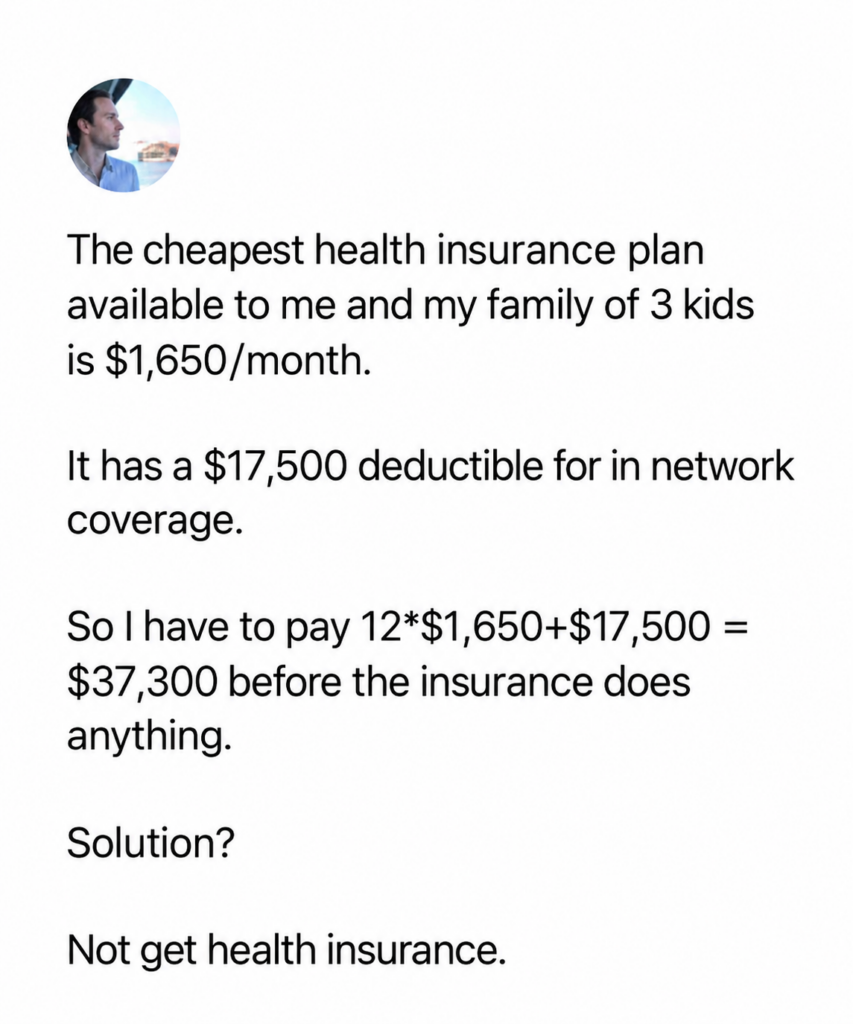
We’re treating those figures as one person’s report, not a verified plan. A screenshot can’t tell us what the plan covers before the deductible, whether the family qualified for financial help, or whether it was the right plan for them.
The frustration behind the post is real, though. A $1,650 premium adds up to $19,800 a year. For self-employed people whose income rises and falls, a fixed bill that size can be genuinely hard to carry. Add a high deductible, confusing benefit language, denied claims and long hold times, and coverage can feel like a bill with no product attached.
If you’ve felt that way, you’re not wrong to question the value. Below, we walk through what that calculation gets right, what it leaves out, and how to judge whether your own coverage is both affordable and protective.
Is it really “$37,300 before insurance does anything”?
The arithmetic in the post is correct. The conclusion drawn from it is not.
| Item | Amount |
|---|---|
| Monthly family premium (as reported) | $1,650 |
| Annual premiums ($1,650 × 12) | $19,800 |
| In-network family deductible (as reported) | $17,500 |
| Premiums + deductible | $37,300 |
Here is what that total leaves out.
Premiums and the deductible are separate buckets. The premium is what you pay each month to keep coverage active, whether or not you use care. The deductible is what you pay for covered services before the plan starts sharing costs (HealthCare.gov). Premiums never count toward the deductible.
The deductible isn’t automatically owed. It’s incurred only when the family uses covered care. In a healthy year, the amount actually spent toward it might be zero or a few hundred dollars. It isn’t a second annual bill.
A deductible can be met before most premiums are paid. If a serious accident happens in March, the family may have paid three premiums ($4,950), not twelve. One hospital stay can satisfy the deductible, and cost sharing starts then. The remaining premiums are still owed to keep the policy active, but the plan doesn’t wait for them before paying claims.
Meeting the deductible isn’t the finish line. Many plans then charge copays or coinsurance until you reach the out-of-pocket maximum, explained in the next section.
Does insurance cover anything before the deductible?
Often, yes — but it depends on the plan.
- Negotiated rates. Members of plans with a provider network pay the insurer’s discounted rate, even before the deductible. HealthCare.gov’s example shows an $85 in-network office visit versus $150 for someone without coverage (HealthCare.gov). To be fair, a cash price is sometimes lower than a negotiated rate, especially for simple services.
- Copays before the deductible. Many plans pay for some services, such as checkups or certain visits, before you meet the deductible. Check your plan details.
- Preventive care. Marketplace plans generally cover a specific list of preventive services, like immunizations and screening tests, at no cost from in-network providers. HealthCare.gov notes that $0 isn’t guaranteed in every case (HealthCare.gov). Diagnostic care is different: a test ordered to investigate symptoms usually goes through the deductible.
How do family deductibles actually work?
Family plans often have both an individual deductible for each person and a family deductible for the household.
- Embedded deductible: each person has their own deductible inside the family amount. Once one person meets theirs, the plan starts sharing costs for that person, even if the family total hasn’t been reached.
- Aggregate deductible: the family’s combined spending must reach the full family deductible before the plan shares costs for anyone.
Out-of-pocket limits work separately. On non-grandfathered ACA-compliant plans, no one person in a family plan can be charged more than the self-only out-of-pocket limit for covered, in-network essential health benefits. That cap is $10,600 for 2026 plans and $12,000 for 2027 plans (CMS/DOL FAQ; CMS 2027 guidance). So on a compliant plan, a single family member’s illness can’t by itself require the household to pay a full $17,500 family deductible for that person’s covered in-network care.
What the screenshot can’t tell us: whether that particular plan has pre-deductible copays, an embedded or aggregate deductible, what its out-of-pocket maximum is, or whether it is ACA-compliant coverage at all. Those details change the answer.
What protects you during a medical catastrophe?
The number that matters most in a bad year isn’t the deductible. It’s the out-of-pocket maximum.
| Term | What it means | Counts toward the out-of-pocket maximum? |
|---|---|---|
| Premium | What you pay each month to keep coverage active, whether you use care or not | No |
| Deductible | What you pay for covered services before the plan starts sharing costs | Yes, on ACA-compliant plans |
| Copay | A fixed amount for a covered service, such as $30 for a visit | Yes, for covered in-network care |
| Coinsurance | Your percentage of a covered service’s allowed cost, such as 20% | Yes, for covered in-network care |
| Out-of-pocket maximum | The most you pay for covered in-network services in a plan year; after that, the plan pays 100% of covered benefits | — |
Definitions adapted from HealthCare.gov’s glossary. For Marketplace plans, the out-of-pocket limit can be no more than $10,600 for an individual and $21,200 for a family in 2026, rising to $12,000 and $24,000 in 2027.
A better planning figure
For comprehensive coverage with an annual out-of-pocket limit, a more useful worst-case number is:
Annual premiums + applicable out-of-pocket maximum = your planning figure for covered, in-network care in one plan year.
Don’t add the deductible on top. It’s already counted inside the out-of-pocket maximum.
The post didn’t mention the plan’s out-of-pocket maximum, so here is an assumption for illustration only. If that family plan were ACA-compliant and its out-of-pocket maximum were the highest allowed for 2026:
| Hypothetical illustration | Amount |
|---|---|
| Annual premiums | $19,800 |
| Family out-of-pocket maximum (assumed at 2026 legal limit) | $21,200 |
| Planning figure for covered in-network care | $41,000 |
That’s higher than $37,300, and it’s worth saying plainly: a high-deductible plan can still be an expensive plan. The difference is that this figure is a ceiling on covered in-network cost sharing. Without coverage, there is no ceiling.
What the planning figure doesn’t include
- Services the plan doesn’t cover
- Most out-of-network care, plus charges above the plan’s allowed amount
- Lost income while you or a family member can’t work
- Travel, lodging, childcare and other costs of being sick
When a crisis spans two plan years
Most individual plans reset deductibles and out-of-pocket maximums each January 1. A diagnosis in October with treatment continuing into spring can mean two years of cost sharing. In this example, that could be up to $21,200 in 2026 plus up to $24,000 in 2027, before premiums.
One more caution: this formula applies to comprehensive coverage with a real out-of-pocket limit. It doesn’t work for limited-benefit products, which may have no such limit at all. More on that below.
What does a hospital stay cost without insurance?
There’s no single price, and that uncertainty is part of the risk. HealthCare.gov offers two educational examples: treating a broken leg can cost $7,500, and three days in the hospital can cost $30,000 (HealthCare.gov). These are illustrations, not current national averages or price ceilings.
It also helps to know that “cost” means different things depending on who’s talking:
| Term | What it means |
|---|---|
| Billed charges | The hospital’s list price on the bill, before any discount |
| Negotiated (allowed) amount | The rate an insurer has agreed to pay a network provider |
| Hospital production cost | What it costs the hospital to deliver care: staff, supplies, facilities |
| Cash or self-pay price | A price offered to patients paying directly, often discounted from charges |
| Patient responsibility | What you actually owe after insurance, discounts or assistance |
These numbers are not interchangeable. A figure for one should never be read as another.
What federal data shows about hospital costs
The Agency for Healthcare Research and Quality’s 2022 national data covers 32.9 million inpatient stays in nonfederal acute care hospitals, with $548.5 billion in aggregate hospital costs (AHRQ HCUP Statistical Brief #316). Dividing aggregate cost by the number of stays gives a rough average hospital cost per stay:
| Reason for the hospital stay (2022) | Approximate hospital cost per stay |
|---|---|
| All inpatient stays | $16,700 |
| Sepsis (septicemia) | $24,800 |
| Fracture of lower limb | $27,400 |
| Heart attack | $28,100 |
| Traumatic brain injury or concussion | $29,800 |
Our calculation from AHRQ Table 1, rounded to the nearest $100. These are hospital production costs — what it costs the hospital to provide care. AHRQ notes they are not the amount paid by anyone, and they exclude separately billed physician fees. Billed charges are typically higher; what an uninsured patient ultimately owes may be higher or lower.
Why a serious event rarely means one bill
Major trauma, ICU care, emergency surgery and cancer treatment usually generate many separate bills: the hospital facility, surgeon, anesthesiologist, radiology and imaging, pathology and lab work, consulting specialists, medications, rehabilitation and follow-up visits. Cancer treatment can continue for months, and costs can stack up across more than one calendar year.
A hypothetical $250,000 medical episode
This is an illustration, not a price estimate. We are assuming $250,000 as the total allowed amount for covered, in-network care. It is not an average cost and not tied to any specific diagnosis.
Assumed plan terms (hypothetical, 2026, ACA-compliant family plan): $17,500 family deductible with an $8,750 embedded individual deductible, 20% coinsurance, and a $10,600 individual out-of-pocket maximum. One family member needs care.
| Insured (hypothetical plan) | Uninsured | |
|---|---|---|
| Amount at issue | $250,000 assumed allowed amount | Whatever the providers bill, before any discounts |
| Deductible paid | $8,750 | Not applicable |
| Coinsurance paid | $1,850 (20% until the limit is reached) | Not applicable |
| Patient’s cost sharing | $10,600, capped by the out-of-pocket maximum | No plan-imposed cap |
| Plan pays | $239,400 | $0 |
| What still applies | Premiums, noncovered services, out-of-network charges | Final amount depends on actual bills, self-pay discounts, financial assistance and negotiation |
We can’t say an uninsured patient would owe exactly $250,000. They might qualify for financial assistance or negotiate a lower amount. They might also be billed at charges well above an insurer’s negotiated rate. The point is the difference in predictability: the insured family knows its ceiling in advance. The uninsured family finds out afterward.
What are the risks of not having health insurance beyond the hospital bill?
The bill is only one part of the exposure. Going uninsured also changes how people use care, how they handle debt, and how a family’s finances hold up after a bad year.
Delayed care. In 2024, 38.6% of uninsured adults delayed, skipped or didn’t get needed care or medication because of cost, compared with 17.0% of adults with private coverage (KFF). A problem caught late can be harder and more expensive to treat.
Medical debt and drained savings. KFF reports that 62% of uninsured adults under 65 have health care debt, compared with 44% of insured adults. Uninsured adults are more likely to use up savings, struggle with other living expenses or borrow money because of it. KFF also found that 59% of uninsured adults said they probably or certainly couldn’t come up with $2,000 for an unexpected need within a month.
That doesn’t mean one emergency automatically leads to bankruptcy. Outcomes vary widely. But the cushion most families have is thin compared with what a serious event can cost.
Ongoing specialty care. An emergency is often the beginning, not the end. Oncology, cardiology, physical therapy and specialty medications can continue for months. Without coverage, each appointment becomes a separate negotiation.
Lost income. For self-employed people, a serious illness can stop revenue at the same moment bills arrive. Health insurance pays medical bills; it doesn’t replace your income. That’s the job of disability insurance or business-overhead coverage, which are separate products worth a separate conversation.
Doesn’t the ER have to treat me anyway?
Partly. Under a federal law called EMTALA, hospital emergency departments that receive Medicare funds must provide an appropriate medical screening exam, treatment to stabilize an emergency medical condition, or an appropriate transfer, regardless of insurance or ability to pay (CMS).
That’s an important protection, but it has limits. It doesn’t make the care free; you can still be billed. And it covers screening and stabilization, not the follow-up surgery, rehabilitation, specialist visits or medications that often come after.
Can’t I just save the premium instead?
Saving is smart, and it can handle routine costs well. The problem is timing. A fund built from a $1,650 monthly premium would hold $4,950 after three months and $19,800 after a full year. HealthCare.gov’s example of a three-day hospital stay is $30,000. If something serious happens early, the fund hasn’t had time to grow, and insurance can’t be bought after the fact to cover it.
What does underinsured mean?
Having an insurance card doesn’t guarantee adequate protection. Being underinsured means you have coverage, but your costs are still high enough relative to income to make care hard to afford.
The Commonwealth Fund counts adults as underinsured if their out-of-pocket costs (not counting premiums) reach 10% or more of household income, 5% or more for lower-income households, or if their deductible is 5% or more of household income. By that measure, 23% of U.S. adults who were insured all year were underinsured in 2024 (Commonwealth Fund).
Run the post’s numbers through that yardstick: a $17,500 deductible is at least 5% of income for any household earning under $350,000. So the frustration is legitimate. That family may well be underinsured, and that’s a real problem worth solving. But underinsured and uninsured are not the same risk. One has a ceiling; the other doesn’t.
There’s a second kind of underinsurance: owning a product that simply doesn’t cover major medical costs. These products are not interchangeable:
| Coverage type | What it’s designed to do | Annual out-of-pocket limit on covered care? | Watch for |
|---|---|---|---|
| Comprehensive major medical (ACA-compliant, on or off the Marketplace) | Pays a broad set of essential health benefits, including hospital and emergency care | Yes, federally capped for in-network essential benefits | High premiums, narrow networks, enrollment windows |
| High-deductible comprehensive coverage | Same core protections, with lower premiums and more cost before the plan pays | Yes, same federal cap | Routine care can feel “uncovered” until the deductible is met |
| Fixed indemnity and supplemental benefits | Pays set cash amounts for specific events, such as a daily hospital benefit | No; benefits are fixed dollar amounts, not a cap on your bills | Payments may be far below actual charges; per-day and per-year maximums |
| Short-term and other medically underwritten coverage | Temporary or health-question-based coverage, often with lower premiums | Not required by ACA rules; varies by policy | Pre-existing condition exclusions, benefit caps, waiting periods, possible denial at application |
| Health care sharing arrangements | Members share medical costs under the organization’s guidelines | No | Not insurance; payment of claims isn’t guaranteed (NAIC) |
| Discount programs | Discounts at participating providers for a monthly fee | No | Not insurance; you still pay the discounted bill yourself |
Not every non-Marketplace plan works the same way. Some are fully ACA-compliant. Some medically underwritten products offer meaningful benefits for people who qualify, and federal rules on short-term plans have been in flux, with many states setting their own limits (U.S. Department of Labor). The specific policy documents are what count.
“But I have a PPO”
PPO describes how a plan’s provider network works. It says nothing on its own about whether the benefits are comprehensive, whether there’s a dollar cap, or what the out-of-pocket limit is. A comprehensive plan, a limited-benefit plan and even a discount card can all advertise access to a PPO network.
A hospital cash benefit isn’t the hospital bill
A daily hospital benefit can be genuinely helpful for deductibles, travel or lost income. But it pays what the policy says, not what the hospital charges. As a hypothetical: a $1,000-per-day benefit for a three-day stay pays $3,000. HealthCare.gov’s example of that stay is $30,000, which would leave $27,000 unaccounted for.
Is it cheaper to not have health insurance and just pay cash?
For some services, cash really can be cheaper. Self-pay prices for office visits, generic prescriptions, lab work, imaging and some planned procedures are sometimes lower than an insurer’s negotiated rate. Insured people use cash prices too, especially on high-deductible plans.
But a good price on one service doesn’t prove that staying uninsured is safer overall. A few reasons:
- Cash prices are easiest to find for planned care. Emergencies, ICU stays and complicated surgeries rarely come with a price shopped in advance.
- Cash payments may not count toward your plan’s deductible or out-of-pocket maximum if you’re insured and pay outside the plan, unless the plan agrees to credit them. Ask first.
- The risk that matters is the large, unexpected bill, not the routine one. Cash pricing helps with the second far more than the first.
What help is available if you’re uninsured?
There are real resources, but none are guaranteed.
- Good faith estimates. If you’re uninsured or not using insurance, providers usually must give you a good faith estimate when you schedule care at least three business days ahead or ask for one. You may be able to dispute a bill that’s at least $400 more than the estimate (CMS).
- Hospital financial assistance (charity care). Tax-exempt hospitals must have a written financial assistance policy explaining eligibility and how to apply (IRS). Eligibility criteria vary widely by hospital, and not everyone who might qualify receives help (KFF).
- Self-pay discounts and payment plans. Many providers offer them. Terms vary, and a payment plan spreads a bill out without necessarily making it smaller.
- Community health centers and assistance programs. These can help with primary care and some medications, but capacity and eligibility are limited.
It’s worth asking about all of these. Just don’t build a financial plan on the assumption that a hospital will forgive or substantially reduce a large bill. Some patients qualify; others don’t, or never apply.
Can I go without health insurance and buy it when I get sick?
You can legally go without coverage in most states; the federal tax penalty for being uninsured has been $0 since 2019 (CMS). A few states have their own requirement, so check yours. The harder question is whether you can get coverage quickly when you need it. Usually, you can’t.
Marketplace enrollment is limited to set windows. On HealthCare.gov, Open Enrollment for 2027 coverage runs November 1, 2026 through January 15, 2027. Enroll by December 15 for coverage starting January 1; enrollments from December 16 through January 15 start February 1 (HealthCare.gov). States that run their own Marketplace may use different deadlines.
Getting sick isn’t a qualifying life event. Outside Open Enrollment, you generally need a Special Enrollment Period triggered by events such as losing other coverage, moving, marriage or having a baby (HealthCare.gov). A new diagnosis or an accident doesn’t, on its own, open the door. Medicaid and CHIP are the exception; you can apply any time if you may qualify.
Other coverage may be available year-round, with conditions. Some short-term and medically underwritten products can be purchased outside Open Enrollment. But eligibility, health questions, effective dates, pre-existing condition exclusions and waiting periods vary. None of them will retroactively pay for an illness or injury that’s already happened.
What changed with financial help
If premiums are what pushed you toward going uninsured, check current assistance before deciding. The temporary enhanced premium tax credits expired at the end of 2025 (KFF). The original premium tax credit still exists for eligible households, and silver plans can carry cost-sharing reductions for lower incomes (CMS).
One change matters a lot if your income varies: beginning with tax year 2026, people who receive more advance premium tax credit than they qualify for must repay the full excess at tax time (IRS). Estimate carefully and report income changes during the year. Rules can change, so confirm what applies when you enroll.
What should you check before dropping your health insurance?
If your current coverage feels unaffordable, that’s a reason to review it, not necessarily to drop it. Work through these steps first:
- Read your Summary of Benefits and Coverage (SBC) and the policy documents, not just the ID card or a screenshot of the premium.
- Confirm your individual and family deductibles and out-of-pocket maximums, and whether the deductible is embedded or aggregate.
- Check the details that matter in a crisis: your doctors, preferred hospitals, prescriptions, exclusions and how hospital stays and surgery are covered.
- Compare the full picture: annual premiums, the routine care you expect to use, and your worst-case covered exposure (premiums plus the out-of-pocket maximum).
- Check current Marketplace financial help and whether your income qualifies for cost-sharing reductions on a silver plan.
- Look at every alternative: Medicaid or CHIP for anyone in the household, a spouse’s employer plan, and other coverage that fits your situation.
- Ask a licensed agent to explain the tradeoffs and confirm plan-specific answers you can’t find in writing.
- Confirm you’re eligible for replacement coverage, and its start date, before canceling anything. A gap of even a few weeks is a real risk.
A lower premium may or may not be available, and a cheaper plan won’t necessarily offer the same benefits. The goal is to know exactly what you’d be giving up before you give it up.
How do you know if your plan would hold up in a major medical event?
Whether you’re keeping your current plan or comparing a new one, ask these questions. If you can’t find a clear answer in writing, ask the insurer or your agent before you need it.
- What would this plan pay toward a serious illness or accident, such as a hospital stay with surgery?
- What costs would remain my responsibility, in dollars, up to what limit?
- Does the stated out-of-pocket maximum apply to this kind of event, and to every family member?
- Which services are excluded, capped per day or per year, or limited for pre-existing conditions?
- Are my preferred hospital, surgeons and specialists in network?
- What happens if I’m taken to an out-of-network emergency room?
- Does the plan pay the hospital directly, or pay me a fixed cash amount?
- Could I afford the exposure if treatment continued into the next plan year?
If the answers leave you with no clear ceiling on what a bad year could cost, that’s the gap to fix first.
So, is health insurance worth it?
For most households, yes, as long as it’s real protection at a cost you can sustain. The math in that post was correct; the conclusion wasn’t. Premiums plus a deductible isn’t what you pay before insurance “does anything,” and it isn’t the true worst case either. The real comparison is a known ceiling on covered costs versus no ceiling at all.
That doesn’t make a $1,650 premium easy, and it doesn’t make every plan a good value. If your coverage feels like it costs too much for what it delivers, you may be underinsured, overpaying, or in a plan that doesn’t fit how your family uses care. Those are problems worth solving. Dropping coverage rarely solves them.
Open Enrollment for 2027 coverage begins November 1. Our 2027 Open Enrollment guide walks through key dates and what to compare. If you’re self-employed or a 1099 contractor, you can also explore self-employed health insurance options.
Want a second set of eyes on your coverage? Schedule a free consultation with 1099 Health Insurance. We’ll help you understand what your current plan actually covers, what a bad year could cost, and which options may be available where you live. It takes about 15 minutes, and there’s no pressure to enroll.
Frequently asked questions
Is health insurance worth it if I rarely go to the doctor?
Usually, yes. The main value isn’t routine visits; it’s protection from a large, unexpected bill. Healthy people still have accidents and sudden illnesses, and coverage can’t be bought after the fact. If you rarely use care, a plan with a lower premium and higher deductible may fit, as long as you could handle its out-of-pocket maximum.
Does health insurance cover anything before the deductible?
Often. Marketplace plans generally cover specified in-network preventive services at no cost, many plans charge flat copays for some visits or prescriptions before the deductible, and network members pay negotiated rates. Check your Summary of Benefits and Coverage for your plan’s specifics.
Is it cheaper to not have health insurance?
In a healthy year, it can be. In a bad year, it rarely is, and no one knows in advance which kind of year it will be. Going uninsured trades a predictable cost for an unpredictable one with no upper limit.
Does my deductible include my monthly premiums?
No. Premiums keep your coverage active. Your deductible is what you pay for covered care before the plan starts sharing costs. Premiums also don’t count toward your out-of-pocket maximum.
What happens if I need emergency surgery without insurance?
Under EMTALA, a hospital emergency department must screen you and stabilize an emergency medical condition regardless of ability to pay. You will still be billed, often by several providers. Ask the hospital’s financial counselor about financial assistance, payment plans and whether you may qualify for Medicaid.
Can I buy health insurance after I get sick?
Not usually right away. Marketplace plans require Open Enrollment or a Special Enrollment Period, and getting sick doesn’t qualify on its own. Once you’re enrolled, ACA-compliant plans cover pre-existing conditions, but other products may exclude them. No plan pays retroactively for care you needed before coverage began.
Can I be underinsured even if I have a PPO?
Yes. PPO describes a provider network, not the strength of the benefits. A PPO plan can still have a very high deductible relative to your income, or it can be a limited-benefit product with caps and exclusions. The benefit documents, not the network label, tell you how protected you are.
Sources
All links checked October 13, 2026. Figures and rules can change; verify before relying on them.
- HealthCare.gov: Pay less even before you meet your deductible
- HealthCare.gov: Deductible (glossary)
- HealthCare.gov: Out-of-pocket maximum/limit (glossary)
- HealthCare.gov: Preventive health services
- HealthCare.gov: Why bother with health insurance?
- HealthCare.gov: When can you get health insurance?
- HealthCare.gov: Special Enrollment Periods
- CMS: 2027 benefit year payment parameters guidance (January 29, 2026)
- Departments of Labor, HHS and Treasury: ACA Implementation FAQs Part XXVII (embedded self-only out-of-pocket limit)
- CMS: You have rights in an emergency room under EMTALA
- CMS: Medical bill rights (No Surprises Act)
- AHRQ: HCUP Statistical Brief #316, National Inpatient Hospital Costs: The Most Expensive Conditions by Payer, 2022 (February 2026)
- KFF: Key Facts about the Uninsured Population (June 16, 2026)
- Commonwealth Fund: The State of Health Insurance Coverage in the U.S.: 2024 Biennial Health Insurance Survey
- NAIC: Not All Products Are Health Insurance
- U.S. Department of Labor: Departments’ statement on short-term, limited-duration insurance (August 7, 2025)
- IRS: Financial assistance policies (FAPs)
- IRS: Repayment caps eliminated for excess advance payments of the Premium Tax Credit